β-hairpins, two antiparallel β-strands bridged by a short turn loop, recur throughout protein architecture as nucleation points for globular folding, as recognition surfaces in antibody-antigen complexes, and as structural units in amyloid fibrils linked to Alzheimer's, Parkinson's, and Huntington's diseases. Reproducing their geometry in synthetic, macrocyclic peptides would open routes to protein-protein interaction inhibitors and responsive biomaterials, but sequence-dependent folding propensity makes stable β-sheet formation in short or challenging sequences, such as polyalanine, notoriously difficult to engineer. Existing turn-inducing linkers such as D-Pro-Gly and D-Pro-L-Pro are effective but structurally limited in their side-chain diversity.
Researchers in the Cai Group at the University of South Florida, published in the Journal of the American Chemical Society, report sulfonyl-γ-AAs, γ-substituted-N-sulfonyl-N-aminoethyl amino acids, as a new class of artificial β-turn inducers that drive stable antiparallel β-sheet conformations in macrocyclic peptides. The team synthesized a series of sulfonyl-γ-AA-templated macrocyclic peptides and characterized their solid-state and solution structures by single-crystal X-ray diffraction, circular dichroism, CD, spectroscopy, and 2D NMR spectroscopy. The sulfonamido moiety of each residue contributes an intrinsic backbone curvature that the group had previously observed in helical foldamers; here they reasoned that same curvature could enforce β-turn geometry when placed at the loop position of a macrocyclic β-hairpin scaffold.
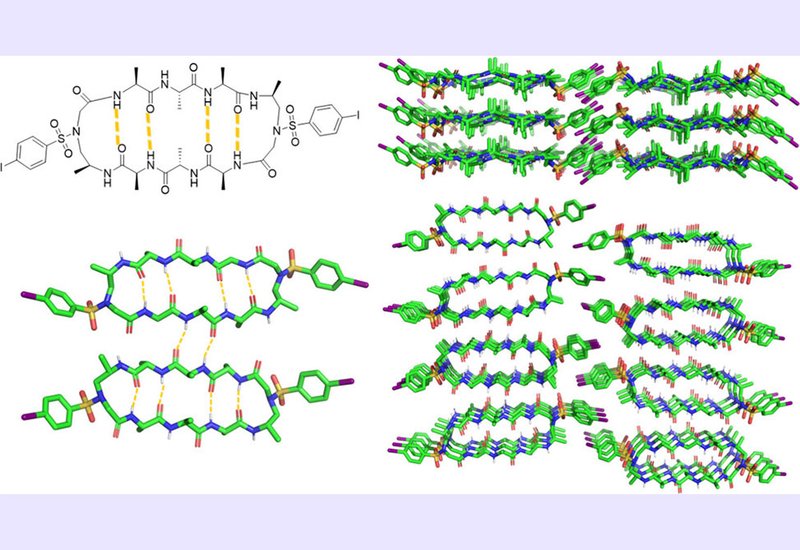
X-ray crystal structures of D-sulfonyl-γ-AA monomer B1 and the macrocyclic peptide BS-1, which pairs two trialanine strands via an L-sulfonyl-γ-AA turn, confirmed the design logic. BS-1 displays an i to i + 3 intramolecular hydrogen bond characteristic of a β-turn motif, and the inter-strand hydrogen bonds follow the alternating close-and-wide spacing pattern expected for antiparallel β-sheets. The authors describe this as the first crystallographic validation of a polyalanine β-sheet structure enforced by a β-turn mimic. Moving to D-sulfonyl-γ-AA-templated macrocycles BS-6 through BS-9, CD spectroscopy in 10 mM KF solution at pH 7.3 revealed characteristic minima between 208 and 214 nm, consistent with β-sheet signatures. Shortening strand length from five to four residues in BS-9 had minimal effect on folding, while the three-residue variant BS-10 showed a broadened minimum near 205 nm, indicating reduced β-sheet character consistent with fewer interstrand hydrogen bonds.
To benchmark D-sulfonyl-γ-AA against established turn motifs, the team synthesized BS-11 and BS-12, each pairing one D-sulfonyl-γ-AA turn with either D-Pro-Gly or D-Pro-L-Pro at the second turn position. CD thermal denaturation studies showed BS-6, carrying two D-sulfonyl-γ-AA turns, maintained its β-sheet signature below 45 °C before unfolding, while BS-11 and BS-12 retained folded conformations up to 55 °C. The authors conclude that the current D-sulfonyl-γ-AA unit is a somewhat weaker inducer than D-Pro-Gly or D-Pro-L-Pro individually, while still supporting stable β-sheet geometry at physiological temperatures. 2D NMR studies on BS-7, BS-11, and BS-12, using TOCSY and ROESY or NOESY experiments, revealed key NOE cross-peaks and downfield α-proton chemical shifts across residues in both strands, consistent with antiparallel β-sheet folding. NMR-derived solution structures confirmed the antiparallel arrangement in all three peptides, and intramolecular hydrogen bonding within the sulfonyl-γ-AA turn region was present in each case.
Sulfonyl-γ-AAs combine the turn-inducing capacity of classical β-turn mimics with the broad side-chain diversity inherent to the γ-AApeptide platform, offering sites for post-synthetic modification and protein-surface contacts that rigid dipeptide surrogates cannot easily provide. The authors envision applying sulfonyl-γ-AA-mediated β-sheets to disrupt protein-protein interactions and to design environmentally responsive biomaterials, such as pH-sensitive hydrogels capable of controlled drug release or support of tissue regeneration. Expanding the chemical diversity of the sulfonyl group itself may yield stronger turn inducers, extending the utility of this scaffold across a wider range of therapeutic and materials applications.